

Ignite NEB Aveiro Region
Youth Belonging & Social Innovation Lab
A results-driven proposal led by APPJuventude, with CIRA as territorial partner and designated Incubation Lead through IERA, designed to transform youth participation into validated NEB solutions, new legal entities and a replicable regional innovation model.
Evaluator focus: ready-to-deliver structure
Every core requirement of the Ignite NEB call is translated into measurable outputs, named responsibilities and evidence for reporting.
EITHE08.1 participants
Registered participants in non-degree education and training activities, including changemakers, challenge owners, coaches and wider community participants.
Youth-led ideas
Ideas developed through local challenge analysis, NEB ideation, mentoring and structured pitching.
Validated solutions
Two winning teams supported to prototype, test with users and improve their NEB solutions.
EITHE04.1 legal entities
Two new legal entities formally set up to implement the solutions born out of Ignite NEB Aveiro Region.
A direct response to the implementation gap in youth participation
The proposal addresses a regional challenge: young people are frequently involved in consultation, but too rarely supported to turn their ideas into tested solutions, sustainable initiatives or new entities. Ignite NEB Aveiro Region creates the missing pathway between participation, incubation and implementation.
Regaining a sense of belonging
The project strengthens young people’s ability to influence public spaces, services, community life and regional identity through co-created solutions.
Real needs and co-designed commons
The project addresses real needs in urban and regional spaces and supports the co-design of public realm and commons with civil society.

Regional living lab
The Aveiro Region combines urban, coastal, rural, cultural and entrepreneurial dynamics suited to NEB experimentation.
Two partners, clear roles, one implementation ecosystem
The proposal is deliberately simple and operational: APPJuventude coordinates the youth and methodology dimension; CIRA acts as territorial partner and designated Incubation Lead; IERA provides the regional backbone for entrepreneurship, workspace, prototyping and testing support.
APPJuventude
Coordinator and methodology lead. Responsible for youth mobilisation, non-formal education, facilitation, inclusion, NEB co-creation tools, communication, quality monitoring and reporting.
CIRA · Região de Aveiro
Territorial partner and designated Incubation Lead. Responsible for municipal mobilisation, challenge-owner engagement, stakeholder connection, testing contexts and access to IERA.
IERA ecosystem
Incubation backbone. Provides regional entrepreneurship infrastructure through 12 poles, incubation services, workspace, business support and links to the University of Aveiro and AIDA CCI.

Evidence that the proposal is ready to implement
The design of the proposal is supported by existing regional assets, clear partner roles and measurable delivery commitments.
11 municipalities
The Aveiro Region is an intermunicipal territory with diverse urban, coastal and rural realities, making it a relevant context to test a shared youth-led NEB pathway.
12 IERA poles
IERA provides a regional network of incubation spaces and services, allowing the project to connect ideas with infrastructure, mentors, stakeholders and testing contexts.
Defined outputs
The proposal defines clear targets: 50+ participants, 10–15 ideas, 2 winners, 3 prototyping sessions per team, 20 users/stakeholders per team and 2 legal entities.
Mobilisation route: municipal mobilisation, open regional call and targeted outreach through youth councils, schools, youth associations, IERA and APPJuventude/CIRA channels.
Challenge-owner route: municipal, business, academic, cultural/creative and civil society profiles will contribute to local challenge framing and validation.
Assessment route: the jury will include NEB, entrepreneurship/incubation, municipal/community, youth participation and cultural/creative/design perspectives.
Reporting route: attendance records, evidence logs, mentoring logs, user testing reports, prototype iteration records and final impact documentation.
IERA as the operational bridge from ideas to incubation
The IERA network gives the proposal a credible implementation base: 12 incubation poles, a regional programme of incubation services, business support, workspace, training rooms, mentoring, legal and intellectual-property referral, and access to local testing contexts.
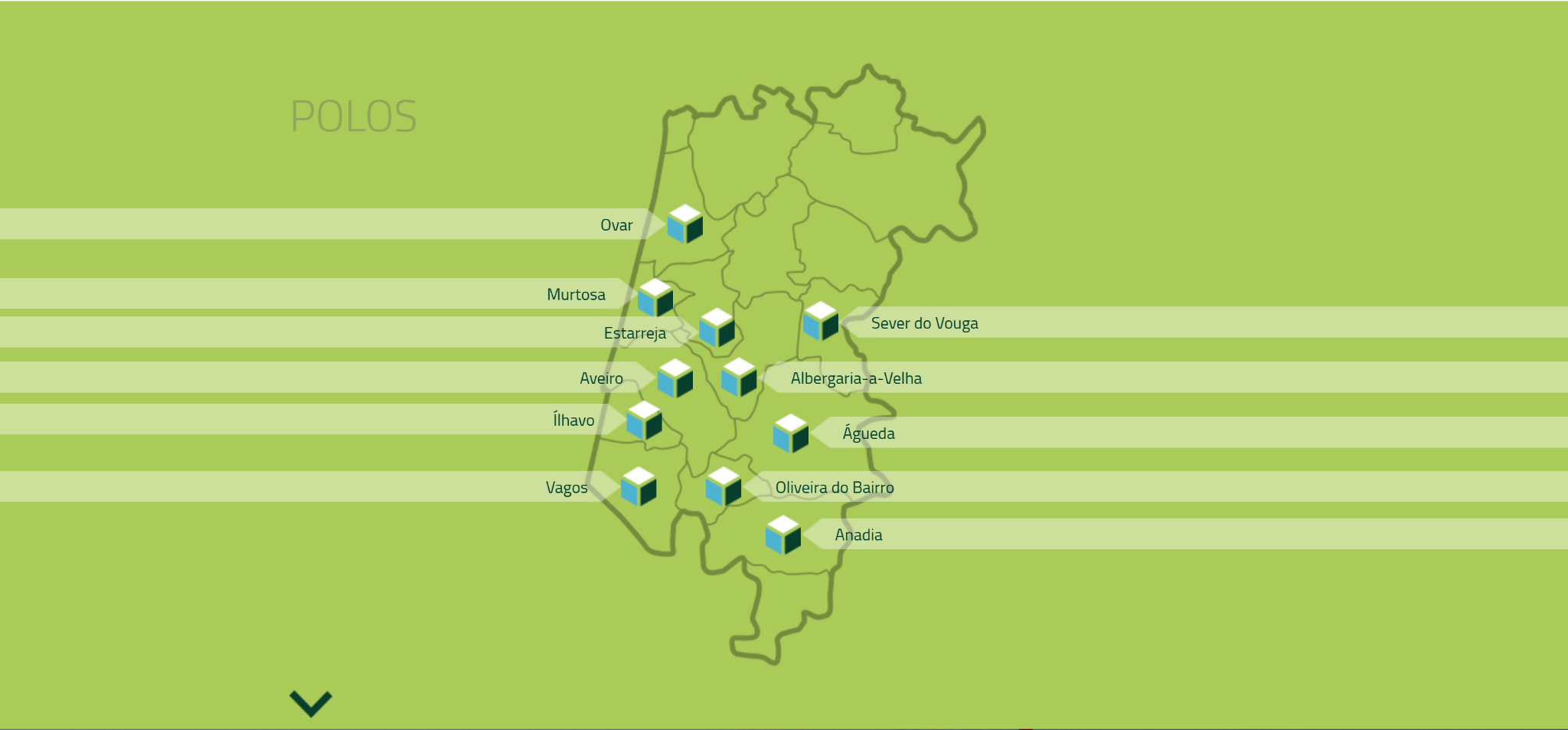
Territorial reach
The proposal can mobilise young people, municipalities and stakeholders across the Aveiro Region, ensuring that the local challenge is addressed at intermunicipal scale.
Incubation capacity
The IERA programme provides workspace, meeting and training rooms, shared services and support for the development of ideas and companies.
Business and social innovation support
Winning teams will be supported to refine value propositions, validate users, test implementation models and prepare legal entity creation.
A 2-day NEB experience, not a conventional hackathon
The event is designed as an “unhackathon”: a creative, inclusive and community-centred experience that combines NEB Celebration with structured ideation, prototyping and pitching.
Belonging, challenge framing and team formation
- NEB inspiration and local challenge framing.
- Challenge owners from municipal, community, business and cultural/creative profiles.
- Team formation and diversity check.
- Youth Belonging Map and Local Challenge Map.
- NEB Celebration: “Belonging in the Aveiro Region”.
Prototyping, validation and winner selection
- NEB Solution Canvas and rapid prototype definition.
- Stakeholder validation and feedback loop.
- Pitch preparation and mentoring.
- Jury presentations.
- Selection and onboarding of 2 winning teams.
| Jury criterion | Weight | Purpose |
|---|---|---|
| NEB alignment | 25% | Ensures strong connection to sustainability, inclusion, aesthetics and sense of belonging. |
| Feasibility and implementation potential | 20% | Assesses whether the solution can realistically move into incubation. |
| Inclusion and community value | 20% | Measures relevance for users, communities and local stakeholders. |
| Sustainability and long-term relevance | 15% | Assesses environmental, social and continuity potential. |
| User experience and aesthetics | 10% | Assesses quality of experience, clarity, accessibility and design value. |
| Team commitment | 10% | Assesses readiness to enter the 8-month incubation pathway. |
A practical route to validated solutions and new legal entities
The 8-month incubation process is designed to reduce implementation risk. Each winning team receives structured support, an action plan, mentoring, prototyping opportunities, user testing, stakeholder validation and preparation for legal entity setup.
Business-oriented pathway
Teams with market-oriented solutions will work on value proposition, demand validation, business model, funding readiness and start-up preparation.
Social-oriented pathway
Teams with community-driven solutions will work on implementation model, governance, stakeholder engagement, sustainability and replication.
Needs assessment
Individual team diagnosis and incubation action plan.
Stakeholder mapping
Solution model and validation targets.
Prototype 1
First prototype or service model.
User testing
Testing with users/stakeholders and feedback report.
Iteration
Improved prototype based on evidence.
Implementation model
Business/social model and sustainability plan.
Legal entity setup
Checklist, documentation and referral support.
Demo Day
Final pitch, roadmap and next-step plan.
Expected outputs and EIT Core KPIs
The proposal is built to generate measurable outputs and evidence for evaluation, monitoring and future replication.
Focused funding allocation for delivery and impact
| Component | Timing | Expected outputs | EIT funding logic |
|---|---|---|---|
| Mobilisation and Ignite NEB event | July–October 2026 | 4 pre-event sessions, 2-day NEB Celebration and Ideation event, jury and two winning teams. | Approx. €24,000 |
| 8-month incubation | 2027 | Mentoring, prototyping, testing, business/social model development, Demo Day and reporting. | Approx. €20,000 |
| Team stipends | After selection | Two stipends of EUR 4,000 to support the two winning teams during incubation. | €8,000 |
| Total requested EIT funding | 2026–2027 | Complete local/regional Ignite NEB programme with measurable outputs and legal entity setup. | €52,000 |
Value for money
The budget is concentrated on direct delivery: mobilisation, event design, incubation, prototyping, testing and team stipends.
Co-funding
In-kind co-funding is provided through staff time, venue access, mentoring, local mobilisation and regional ecosystem support.
Low administrative risk
No subcontracting is budgeted, travel is local/regional and the budget follows the call’s indicative distribution.
Support system for winning teams and reporting
Mentoring and coaching
Structured support in youth participation, NEB values, business modelling, social innovation, stakeholder engagement and pitching.
Workspace and prototyping
Connection to suitable workspaces, prototyping environments, design support and practical experimentation contexts.
User validation
Testing plans, interview guides, surveys, stakeholder validation, user feedback forms and prototype iteration records.
Business and social model
Support for value proposition, governance, sustainability, implementation pathway and future funding readiness.
Legal entity setup
Legal entity setup checklist and one dedicated support session on legal form options, administrative steps, governance and continuation requirements.
Monitoring and reporting
Attendance records, evidence logs, mentoring logs, testing reports, prototype documentation and final impact summary.
A transferable model for youth-led NEB innovation
The project is designed to leave more than an event. Its legacy will be a tested model that other municipalities, intermunicipal communities and youth organisations can adapt: local challenge framing, youth mobilisation, NEB ideation, incubation, user testing, entity setup and Demo Day dissemination.
Local impact
Young people gain a visible role in shaping solutions for the places, services and communities where they live, study, work and participate.
Regional impact
The Aveiro Region gains a practical bridge between youth participation, municipal policy, incubation and entrepreneurship.
European relevance
The model can be shared as a youth-led approach to implementing NEB values through social innovation and business creation.
| Communication output | Target | Purpose |
|---|---|---|
| Landing page | 1 | Central information and recruitment point. |
| Municipal dissemination kits | 11 | Enable each municipality to mobilise local participants. |
| Social media posts | At least 12 | Recruitment, awareness, event visibility and incubation updates. |
| Press releases | 2 | Regional visibility before and after the event. |
| Winning-team stories | 2 | Showcase validated solutions and continuation potential. |
| Final replication brief | 1 | Support transfer to other municipalities and youth organisations. |